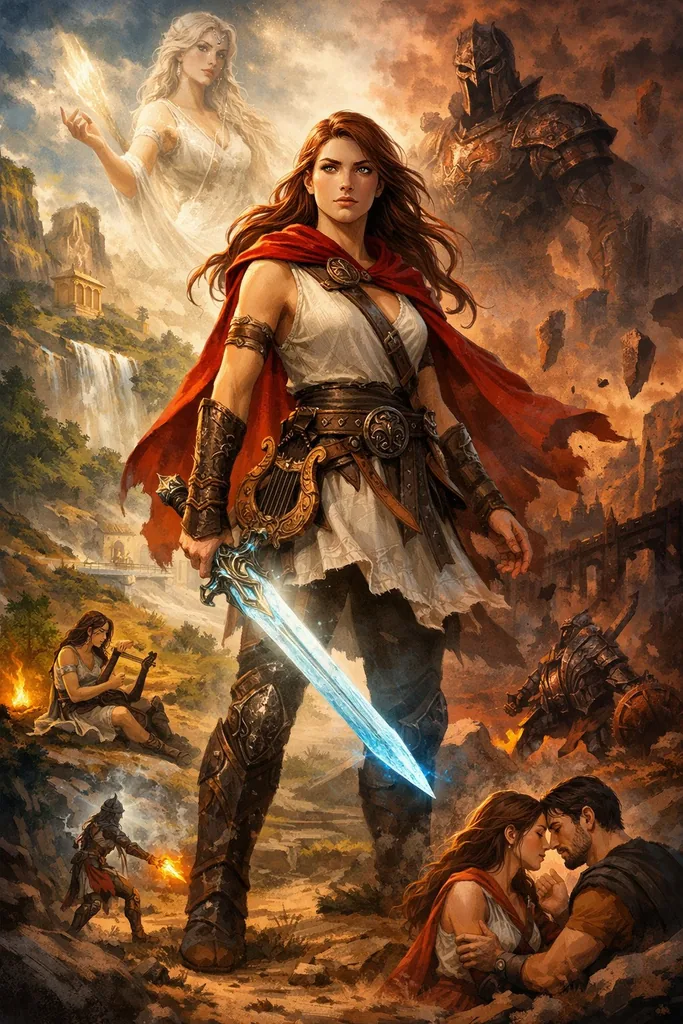
I created a third-person adventure concept for RTA928, connecting game mechanics, key art and a six-act story.
Project decisions & details
Challenge
Give a third-person action-adventure a story spine that actually holds — not just set-pieces.
Outcome
A game concept where structure and world-building are designed together — narrative design, not just visuals.
Audience
Course critique and game-pitch readers
Context
RTA928: Introduction to Game Design
Deliverables
Mechanics, key art, and six-act narrative
Evidence
Two core mechanics, eight aesthetic priorities, and a six-act narrative
PL. 01Kassandra — key art
01
Overview
The player assumes the role of Kassandra — a tale of a young heroine who embarks on a quest to restore harmony to the shattered world of Elysium. The player makes critical decisions and witnesses the transformation of a humble musician into a legendary hero. The game provides players with a rich and emotionally engaging experience that explores the mature theme of personal growth.
Built on a one-time purchase monetization model, Chronicles of Elysium is designed for PC (Steam, Epic Games), PS5, and Xbox Series X — targeting players who value narrative depth, character customization, and emotionally resonant storytelling.
6
Story acts
4
Platforms
35%
Artistic resources
02
Platforms & Release
PC — SteamPC — Epic GamesPlayStation 5Xbox Series X
03
Core Mechanics
01 — PRIMARY
Level-Based Progression
Determining the degree of character customization in-game and how well it works in narrative-driven games indicates the immersion level. This structure allows players to create their own autonomy when articulating commands and getting the outcome they desire the more they play — shaping how each character approaches the environment, implements their skill sets, and defeats various enemy types.
02 — SECONDARY
Dynamic Movement System
A fluid and connected combat system to achieve leveling progression flows into movement. A fast-paced action mechanism to maneuver, dodge, or attack should be efficient — making real-time responsiveness give players the accessibility to learn and master their controllability. Pressing once swings the weapon, twice fires a projectile, holding charges for a strike — each contributing to the character's overall advancement.
04
Pleasure Aesthetics
Using the MDA framework, eight aesthetic categories were evaluated to define the core experience of Chronicles of Elysium.
Fantasy
4/4
Narrative
4/4
Discovery
4/4
Challenge
3/4
Expression
3/4
Sensation
2/4
Fellowship
1/4
Submission
1/4
"The progression in the narrative defines the mantle of the hero — because anyone could be hailed as one, but not everyone can become one."
— Jennings, 2022 · Cited in Chronicles of Elysium narrative design
05
Narrative Structure — The Hero's Journey
The narrative is built on two interlocking frameworks: Aristotle's Poetics (beginning-middle-end, tragedy, catharsis) and Joseph Campbell's Hero's Journey (call to adventure, crossing the threshold, ordeal, return). Together they create a six-act structure that drives both character transformation and player investment.
ACT 1
The Call to Adventure
Elysium's idyllic land, where harmony once reigned, has been disrupted by dark forces beyond its borders. Kassandra, a travelling musician, receives a mystical invitation from an ancient sage dwelling under the World Tree. A prophecy is revealed — only a true hero can retrieve the lost Harmonia Flute and restore balance to Elysium.
ACT 2
Crossing the Threshold
With the support of her companion Cloud, the white cat, Kassandra accepts the call. She meets trusted allies: Jax, The Hardened Warrior, and Eleanor, The Keen Oracle. These individuals provide guidance and set challenges that test and strengthen her for the dark forces ahead.
ACT 3
Tests, Allies, and Enemies
Kassandra faces moral dilemmas and difficult choices — a heart-wrenching betrayal of a team member and the capturing of another. The evil antagonist, Cain, a power-hungry sorcerer controlling dark forces, has caught wind of her and is determined to remove her at all costs.
ACT 4
The Ordeal
Ambushed by Cain on the windy white grasslands, the climactic confrontation erupts. With her weapon of choice — the ukulele — and her three companions, Kassandra must use everything she has learned. Cain destroys her ukulele. Brought to her knees, overwhelmed, our heroine faces complete defeat.
ACT 5
The Revelation
Reaching the Harmonia Flute, it reveals her hidden past — she is Princess Kassandra of Celestis, sent to Elysium without her memories after her royal family was massacred. She realizes true harmony can only be restored by reconciling her inner demons and forgiving herself for her powerlessness. This inner transformation unlocks the Flute's power.
ACT 6
The Return
Kassandra defeats Cain with the power of the Harmonia Flute, restoring harmony to Elysium and bringing justice to Celestis. She must return to close that lost chapter — leaving behind the magical realm and those she has come to love. But as a changed hero, she carries the wisdom of a completed journey — and the potential for a sequel.
06
Reflection
This project reinforced how narrative and gameplay must be fused rather than layered. Traditional linear narratives like Aristotle's Poetics and Campbell's Hero's Journey can interrupt a player-driven game that requires interaction — the challenge is finding the balance where story compels without constraining freedom.
Designing Kassandra's arc — a female protagonist undergoing heightened personal growth — was an intentional exploration of the "Heroine's Journey" as an alternative monomythic framework. Playing a game that leaves players thinking about somebody else's story through their own eyes is, ultimately, the goal of any narrative-driven design.